Imagination as Resistance: Kate Robinson on Honoring her Father’s Legacy and Protecting Creative Spaces
By Susan McCalmonT
Few people have shaped my understanding of creativity as profoundly as Sir Ken Robinson. His work didn’t just influence the global conversation around education, but it moved me on a personal level, as a friend, mentor, and someone whose ideas shape the philosophy behind 1515 Lincoln Gallery.
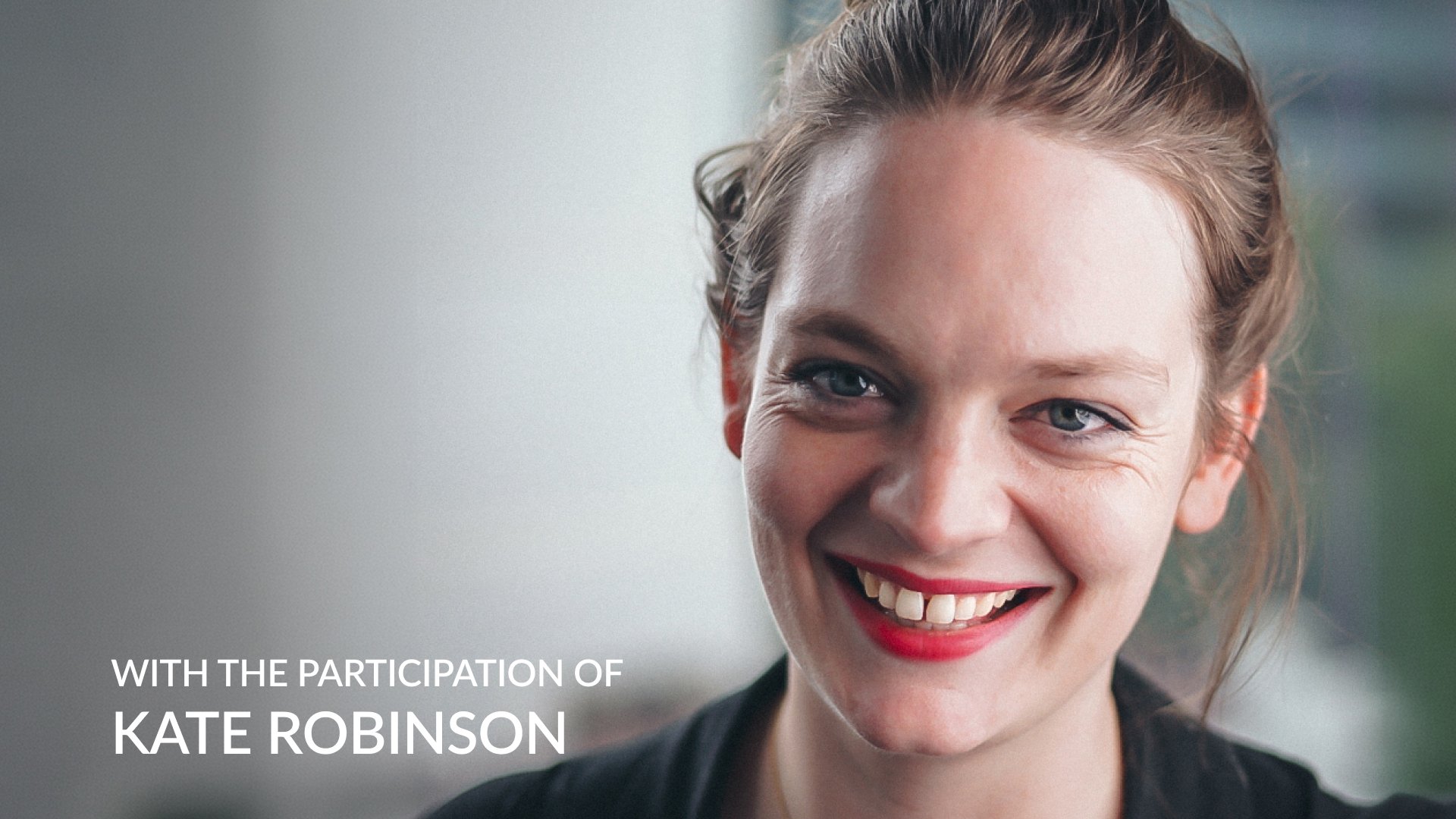
Recently, I had the opportunity to speak with his daughter, Kate Robinson, who continues to carry his meaningful message forward in a world that feels increasingly at odds with it. What struck me most in our conversation was both the responsibility she carries and the way she speaks about what’s at stake. As she put it early on, “Creativity is not a ‘nice to have.’ It is a fundamental human capacity that is a critical part of human intelligence.”
While it’s a simple statement, it challenges how many of our systems are fundamentally structured. And that’s why her work feels so urgent right now.
Carrying Her Father’s Legacy Forward
Kate described her early exposure to her father’s work as something she absorbed naturally. “When I was young a lot of what I learned was almost through osmosis – hearing my parents talk about the importance of creativity from the other room, or in the car or at the dinner table,” she explained.
Her understanding deepened over time as she became more involved with her father’s work, eventually collaborating with him on Finding Your Element (2013), a book focused on helping people discover where their passions and talents intersect.
But after Sir Ken Robinson’s passing in 2020, Kate’s relationship with her father’s work changed in a significant way: “My role was no longer to support him in advocating for creativity, but to advocate for it myself.”
Stepping into the role required more than continuation. It required a transformation. When Kate took on the task of completing her father’s final manifesto, Imagine If… Creating a Future for Us All, she immersed herself in it completely.
“I read every book of his and watched every talk I could, not just to be supportive but to really digest it so I could accurately represent it,” she reflected. “This process deepened my understanding of creativity profoundly.”
The meaningful immersion into her father’s legacy and work helped Kate to see creativity as something more expansive and precise at the same time: “I began to truly understand his definition (the process of having original ideas that have value) and how that applies to all areas of life.”
Finding Creativity in a Culture of Control
One of the most compelling ideas that Kate shared was the contradiction she sees playing out today. “When times are difficult, we often see two opposing phenomena occur at once,” she explained.
On a systemic level, institutions tend to narrow their focus, cutting funding for the arts, and reinforcing rigid structures. “There is often a 'back to basics' push where funding for the arts is slashed as it’s deemed non-essential,” Kate explained.
At the same time, people instinctively move toward creativity as a way of making sense of and processing the world. As Kate noted, “On a human level, we see a collective retreat into the arts for comfort, distraction, and meaning […] Trying times often spark the most profound acts of creativity.”
This contradiction reveals something deeper about how creativity is perceived. “Institutions may label art a luxury, but the human spirit treats it as a necessity for survival,” Kate went on.
Yet, despite this, there’s still a tendency to suppress it. “There is a misconception that to empower creativity is to release chaos, and in an attempt to create order and control during turbulent times, creativity is seen as a threat rather than the solution,” she said.
In systems driven by control and predictability, imagination can be seen as something that needs to be contained rather than cultivated. But as Sir Ken often argued, and Kate continues to emphasize, this way of thinking is a fundamental misunderstanding about what creativity is and the power it holds.
Creativity isn’t simply an add-on. It’s a part of what makes other disciplines possible and helps driven them forward, from the science to mathematics. The issue, Kate notes, lies in how systems are structured: “We compartmentalize too much […] and in doing so we have lost the cross-pollination that makes learning so rich.”
Adapting Her Father’s Message for a Changing World
While Kate’s work is deeply rooted in her father’s ideas, she’s not simply trying to repeat them. Her aim is to move them forward.
“I feel very strongly that my role isn’t to focus on the past or to simply repeat his message as loudly as possible, but to take it where it needs to go,” she told me. “We must adapt and build the message according to the circumstances we are living through.”
One of the most significant shifts she pointed to is the rise of artificial intelligence, something her father was fascinated by but never experienced fully in its current form. “Mainstream generative AI was purely hypothetical in in his lifetime,” Kate explained. “It’s very real to us now and opens critical debate on what true, human creativity is and how that differs from AI’s capacity to be creative from AI’s capacity to be creative.”
This question, what makes creativity distinctly human, feels increasingly relevant as technology continues to evolve. It also underscores the need to better understand and protect the role creativity plays in how we think, learn, and connect with each other.
As part of continuing her father’s work, Kate revisited one of his most influential books. The 25th anniversary edition of Out of Our Minds: The Power of Being Creative, fully adapted by Kate, released on April 30. The new edition reflects on how the role of creativity has evolved, while emphasizing why these ideas are still so relevant. Available to order now, it’s an eye-opening read for anyone looking to reflect on their relationship with creativity.
Building Community to Defend Creativity
To champion for creativity, we need persistence. As Kate says, that “often it means being a lone voice in a crowded room.” It’s why she’s equally focused on building a community that supports her work. Together with her husband Anthony, she launched an online community called the Creative Revolution, which brings together people who advocate for creativity across disciplines and geographies.
“There are people defending creativity in all corners of the world and we are bringing them all together,” she explained.
There’s also a practical side to her advocacy. Kate explained there’s now extensive evidence linking creativity to mental health, fulfillment, and long-term success. But the main challenge is ensuring this knowledge is widely understood and acted upon.
“Defending creativity means to get out and shout about it from the roof tops. We have so much evidence now that speaks to the importance of creativity on everything from mental health to fulfillment to career opportunities,” Kate said, adding, “Our job is to spread this far and wide.”
The Significance of Creative Spaces
My conversation with Kate also reinforced something I often think about in the context of 1515 Lincoln Gallery: the importance of building spaces that bring people together around creativity.
“They play an invaluable role,” Kate said when speaking about local creative communities. “Our world is increasingly digital and while we are in theory more connected than ever before, in reality we are seeing staggering rates of depression, anxiety and feelings of loneliness and disconnection.”
“Bringing people together in the real world to celebrate art and creativity makes all the difference,” she went on. “We have to hold onto our inter-personal, creative connections in the real world if we have any chance of a future worth living.” Creative spaces offer opportunities for shared experience, dialogue, and connection, which are all things that can be difficult to sustain elsewhere.
Still, Kate emphasized the importance of reclaiming creativity on an individual level. “The first step is to challenge your own misconceptions of what creativity is,” she explained. “While the arts are an incredible conduit of creativity, they are not the only field in which it exists. Taking the time to learn about their own, personal creativity is pivotal in reclaiming it.”
As Sir Ken Robinson often said, the question isn’t “How creative are you?” But “How are you creative?” Kate notes, “Investing time in discovering your own personal answer to that question may be one of the most important things you ever do for yourself.”
Using Creativity as a Form of Resistance
As our conversation came to an end, what stood out to me was not just the urgency of Kate’s message, but the sense of possibility that came with it. “I take huge hope in the growing numbers of people who believe in and advocate for creativity,” Kate told me.
“It is easy to assume you are alone in this, but there are millions of us out there. I hope to bring us all together into one, unified movement,” Kate added, concluding with an emphatic, “We are so much stronger together.
In a time where systems often prioritize control and efficiency, choosing to nurture creativity can feel countercultural. But it’s necessary for ourselves and our wider communities. Creativity allows us to adapt and connect. It lets us imagine different possibilities and futures. It creates space for new ways of thinking, even in systems that resist them.
In this way, creativity is more than expression. It’s a way to preserve the essence of what makes us human and a way to shape what comes next.

