The Places Art Takes Us
By Susan McCalmonT
As summer approaches, many of us start looking for ways to step outside of our routines so we can recharge. We often treat rest as something that requires physical distance, a vacation, a weekend away, or some sort of dramatic change of scenery. But lately, I’ve been reflecting on the ways we can experience renewal without ever leaving home.
I think we all need occasional interruptions in our environments to remove us from the mundane and to help gain fresh perspectives. Creativity has often been defined as the “generation of ideas that have value,” and stepping away from our everyday rituals can help clear the mind and soul so imagination can thrive.
Art has always offered that kind of interruption to me. Whether encountered in a gallery, a museum, a book, or even through a screen, art has the power to transport us emotionally and mentally. It creates space for reflection and stillness in a world that often moves too quickly to allow for any of those things.
Why We Feel the Need to “Get Away”
There’s a reason so many people crave an escape during summer. Modern life can feel relentless. We move quickly from obligation to obligation, constantly absorbing information and responding to notifications without allowing for time to simply pause.
Travel helps because it interrupts our routine. It forces us to see and think differently, and to experience our surroundings with greater awareness. But I don’t believe physical travel is the only way to have a shift in perspective.
Art can create a similar experience, transporting our minds somewhere else beyond the body. When we’re immersed in art, whether by viewing or creating, we’re entering a world of discovery and ideas. It’s possible to become so absorbed in a painting, photograph, sculpture, or other type of work that we feel pulled into another dimension entirely.
By “getting lost” in the color, patterns, and subject matter, art can take us to another place and time. Sometimes, it helps us reconnect with long-forgotten memories, while in other cases it opens the door to entirely new thoughts.
That ability to emotionally travel through art is something I think many people instinctively understand, even if they can’t articulate it.
Entering Another World Through Art
I remember a time when I had just finished college and was working a stressful office job in Washington, D.C. During my lunch breaks, I would visit The Phillips Collection to spend time with Pierre-Auguste Renoir’s Luncheon of the Boating Party. I would simply sit in front of the painting and allow myself to enter its world.
There was something restorative about the warmth of the scene and the softness of the light. There was a feeling of ease among the figures that gathered in the piece. For a moment, the pressures of daily life seemed quieter. I always returned to my job feeling calmer and lighter after spending time with the masterpiece.
Experiences like that remind me that art isn’t something to observe from a distance. If we allow it, art can become a place we emotionally inhabit.
Even now, I think many of the most meaningful encounters with art happen when we let ourselves slow down enough to truly experience it rather than simply look at it. Art requires us to pause and observe, to reflect and notice details we may otherwise overlook.
This kind of attention feels rare today, which is perhaps why it feels so restorative when we finally allow ourselves to experience art this way.
What Happens When We Slow Down and Notice Deeply
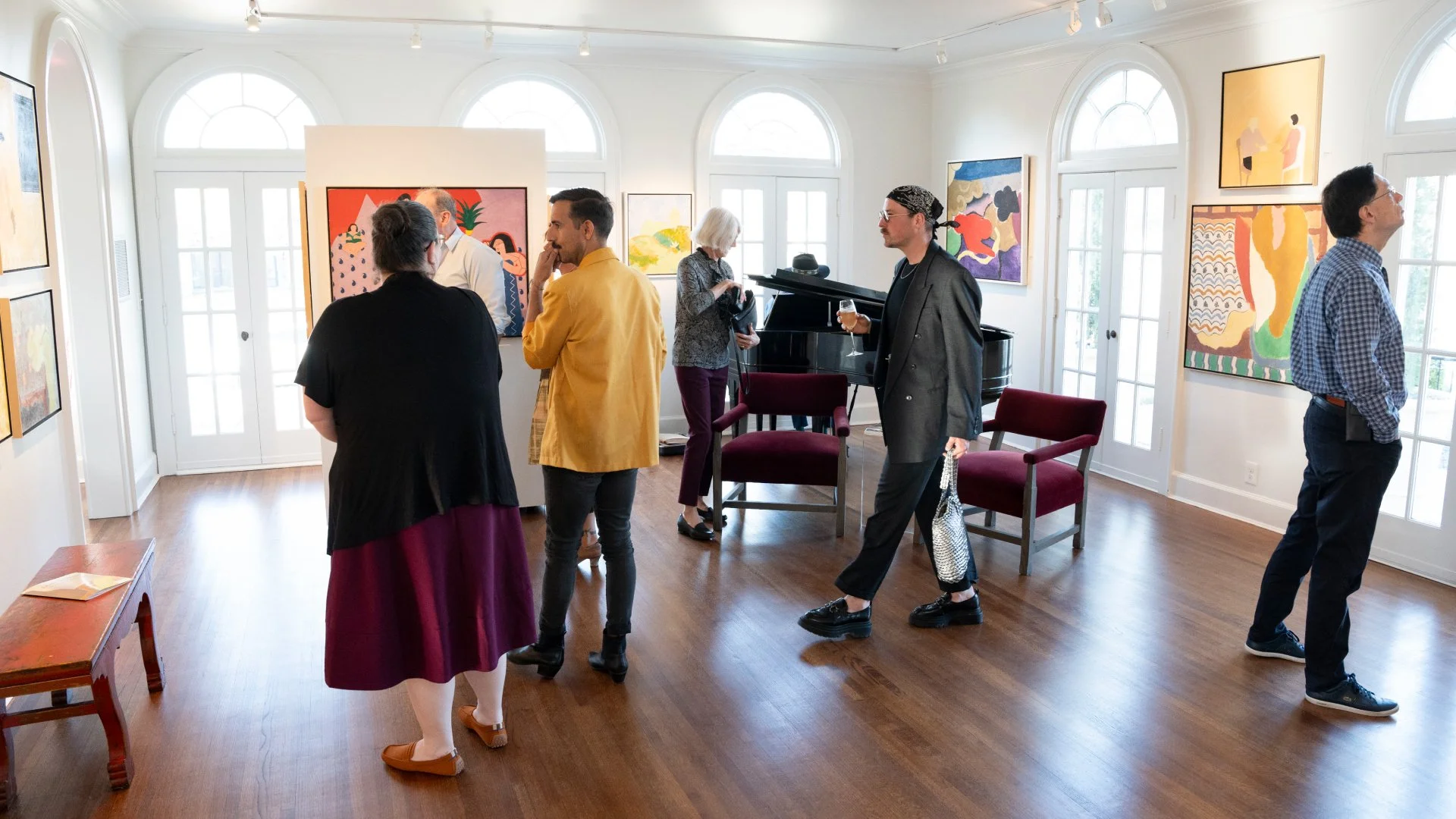
In today’s overstimulated world, galleries and other creative spaces can play an important role in communities. I believe they provide places for repose and reflection, where people can step outside of the pace of everyday life and reconnect with themselves. Taking time out of a busy day to notice deeply can be therapeutic.
One of the easiest exercises I often recommend is choosing a single work of art that speaks to you and spending several uninterrupted minutes with it. Stand or sit in front of the piece and allow yourself to be fully engulfed by the work. Pay attention to the texture, color, composition, and atmosphere. Think about what the artist may hope to convey, but also allow yourself the freedom to recognize your own emotional response.
In many ways, art invites us to practice presence. Creative spaces also offer something that’s increasingly difficult to find elsewhere: permission to slow down without needing to justify it. Unlike so many environments focused on productivity and efficiency, galleries encourage contemplation. They remind us that there’s value in observation and emotional experiences.
The Science Behind the Power of Art
What many people experience intuitively when engaging with art is supported by research. Recently, The Guardian highlighted a study from University College London that looked at the relationship between arts engagement and wellbeing. The research found that participating in artistic and cultural activities, including visiting galleries and museums, is linked to slower biological aging.
The findings were ground-breaking because they showed there are measurable health benefits to experiencing art, not only creating it.
According to the study, engaging with art can:
• Reduce stress
• Improve mood
• Lower inflammation
• Improve cardiovascular health
• Provide greater emotional wellbeing
• Provide stronger feelings of connection and fulfillment
The researchers also noted that people who engaged in artistic activities consistently showed greater benefits over time.
What I find most impressive about the research is that it validates something creative communities have long understood: art isn’t decorative or optional. It has the power to shape how we feel emotionally, mentally, and even physically. In a time where burnout and disconnection are increasingly common, this feels more important than ever.
Why Certain Art Stays with Us
Art doesn’t affect people the same way. Emotional responses to artwork are deeply personal and shaped by our experiences.
Still, I find that the less representational genres create some of the strongest responses because they give viewers more freedom to enter the work without judgement or preconceived notions. Abstract imagery invites the imagination in a way that highly realistic subjects sometimes cannot.
Without needing to interpret a literal narrative, viewers can focus instead on other aspects, like:
• Feeling
• Emotion
• Texture
• Movement
• Atmosphere
This openness creates space for personal interpretation, which is where some of the most meaningful experiences with art begin. Sometimes, the works that have the most impact aren’t the ones we fully understand intellectually, but the ones that makes us feel something that’s hard to explain.
Letting Art Interrupt the Noise
As we move into one of the busiest seasons of the year, I hope this serves as a reminder to slow down and spend time with art in ways that feel meaningful. That doesn’t always require elaborate travel plans or big life changes. Sometimes, restoration happens simply by taking yourself outside of routine long enough to encounter something thought-provoking.
Art can feed the soul if we’re open to it, offering us refreshment and new perspectives. It’s a reminder to pause and reconnect with parts of us that are often overshadowed by the daily pace of life.
In many ways, art offers a different kind of journey, one that doesn’t necessarily take us somewhere new physically, but still allows us to return to ourselves with greater clarity and perspective.
Double-click to edit...

